

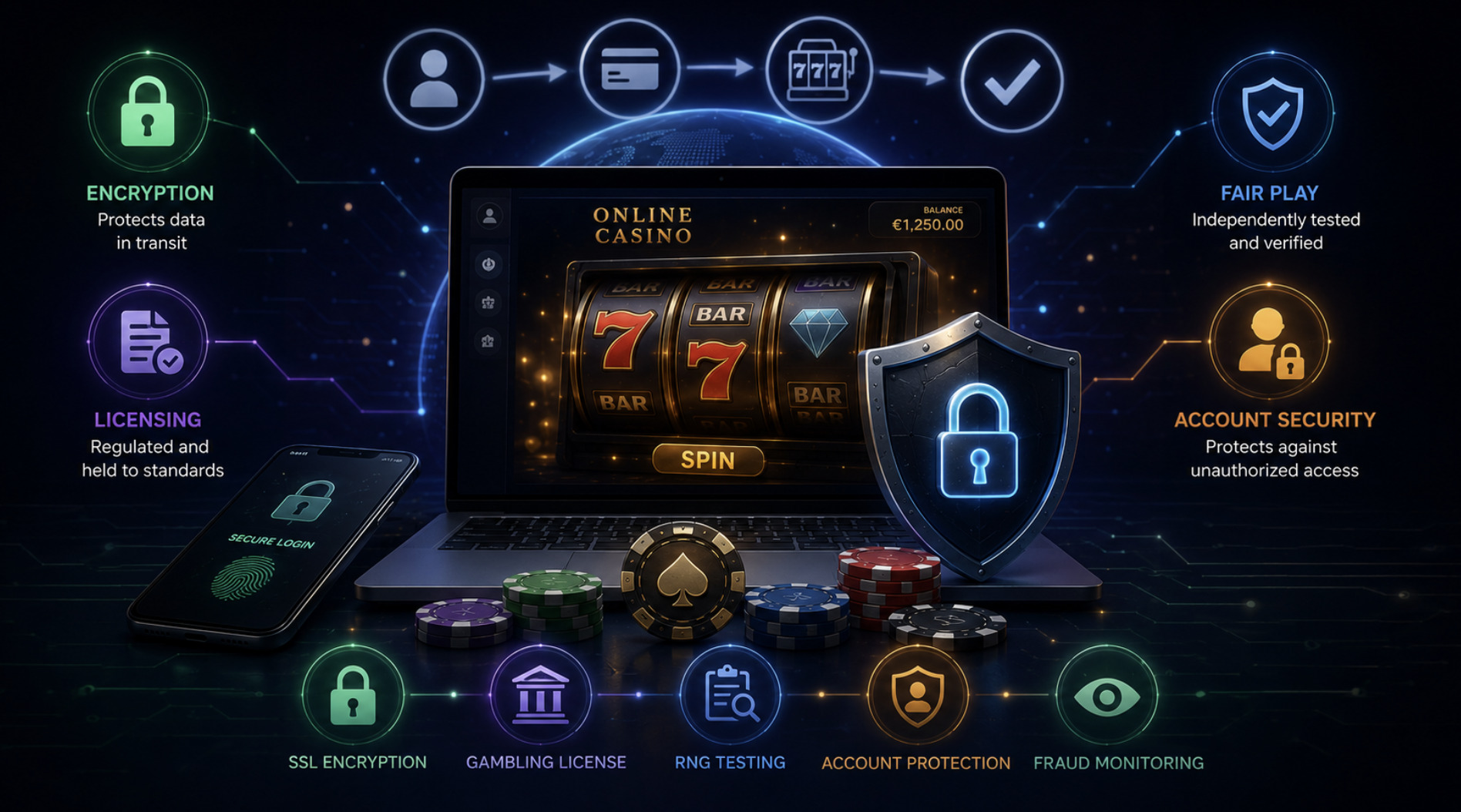
When a player logs into an online casino, deposits money, and spins a slot, an enormous amount of invisible machinery works to keep that interaction safe. Encryption protects the data in transit, licensing frameworks impose standards, independent testing verifies fairness, and account safeguards guard against intrusion. Most players never think about any of it, which is exactly as it should be — good security is unnoticed. But knowing what these systems are, and how to recognise their presence, is what allows a player to tell a trustworthy operator from a risky one. Safety in online gambling is not a feeling; it is a set of concrete mechanisms.
Encryption: the lock on the data
The most fundamental layer of casino security is encryption, the technology that scrambles information as it travels between a player's device and the operator's servers so that anyone intercepting it sees only unreadable data. The same standard that protects online banking — transport-layer encryption, visible as the padlock and "https" in a browser — protects the transmission of login credentials, personal details, and payment information at any legitimate casino. Without it, sensitive data would cross the internet in plain view.
Its presence is the first thing a cautious player should confirm, and it is easy to check: a secure connection is indicated in the browser, and its absence is disqualifying. But encryption in transit is only part of the picture. Reputable operators also protect stored data, applying strong security to the databases that hold player information so that even a breach of their systems does not readily expose usable details. Encryption is the baseline of casino security precisely because everything else depends on the confidentiality of the data flowing through the platform; a site that neglects it fails at the first hurdle.
Licensing: the framework of accountability
Beyond the technical layer sits the regulatory one, and licensing is its cornerstone. A licence from a recognised gambling authority means an operator has agreed to meet defined standards and submits to oversight, audits, and the possibility of penalties or revocation if it fails to comply. These standards typically cover fairness of games, protection and segregation of player funds, anti-money-laundering procedures, responsible-gambling provisions, and mechanisms for resolving disputes. A licence is, in essence, an accountability structure.
The practical value for a player is enormous, because it changes the recourse available when something goes wrong. With a licensed operator, there is a regulator to appeal to and rules the operator is bound by; with an unlicensed one, a player is largely on their own. Licensing information is normally displayed in a casino's footer and verifiable with the issuing authority, and checking it is one of the most important habits a player can adopt. Not all licences carry equal weight, but the presence of a genuine one from a reputable jurisdiction is a strong signal that an operator is subject to real oversight rather than operating in a vacuum.
Verified fairness: proving the games are honest
A distinct security question is whether the games themselves are fair, and this is addressed through independent testing. The outcomes of digital casino games are produced by a random number generator, and the concern any player might reasonably have is whether that generator is genuinely random and untampered. This is resolved not by the operator's assurance but by external, accredited testing laboratories that examine the software, subject the random number generator to rigorous statistical analysis, and verify that the games return what they claim to.
These laboratories issue certifications that a trustworthy operator can point to, and their involvement is what turns "trust us" into "verified by an independent third party." The distinction matters because fairness is precisely the kind of claim that cannot be self-certified credibly. When an operator's games have been tested and certified by a recognised laboratory, a player has genuine grounds to believe the outcomes are honest. A platform such as Spookino that runs certified games and makes that certification evident is demonstrating fairness through verification rather than merely asserting it — which is the only form of the claim that should carry weight.
Account security and the player's own role
Even the most secure platform depends partly on the player, because many breaches happen not through the casino's systems but through compromised individual accounts. This is why reputable operators offer, and increasingly require, account-protection features. Strong, unique passwords are the foundation; two-factor authentication, which adds a second verification step beyond the password, is one of the most effective defences available, because it means a stolen password alone is not enough to access an account.
Identity verification, the KYC process discussed in the context of payments, also serves security by confirming that the person withdrawing funds is the legitimate account holder. Players contribute to their own safety by enabling the protections offered, using a distinct password for their casino account, staying alert to phishing attempts that try to trick them into revealing credentials, and treating any unexpected request for their details with suspicion. Security is a partnership: the operator secures the platform, and the player secures the account. Neglect on either side creates an opening, which is why the strongest protection comes from both taking their part seriously.
Reading the signals of a secure operator
Because so much of casino security is invisible, players benefit from knowing which visible signals indicate its presence. A valid encryption certificate on the connection, a genuine licence from a recognised authority displayed and verifiable, evidence of independent game testing and certification, clear and accessible terms and privacy policies, and robust account-protection options together form a profile of a serious, secure operator. The absence of these signals, or their obscurity, is itself informative.
Equally telling is how an operator handles the human side of security: whether customer support is reachable and competent when a problem arises, whether the site is transparent about its ownership and licensing, and whether it treats data protection as a stated commitment rather than an afterthought. A player cannot personally audit a casino's servers, but they can read these signals, and a platform that displays them consistently is far more likely to be one that has invested in genuine security. Learning to read the signals is the practical substitute for inspecting the invisible machinery directly.
Conclusion
The safety of an online casino rests on layers of largely invisible systems: encryption that protects data in transit and at rest, licensing that imposes accountability and oversight, independent testing that verifies the fairness of the games, and account safeguards that guard against intrusion. None of these announces itself during play, which is why players must learn to recognise the signals of their presence — the secure connection, the verifiable licence, the certification, the account protections, the transparency. Security in online gambling is not a matter of hoping a site is trustworthy; it is a matter of confirming the concrete mechanisms that make trustworthiness real. The player who understands and checks for these systems, and who secures their own account in turn, transforms an act of blind faith into an informed judgement.